An ELSA escape set gives one wearer a short-duration supply of breathing air while the wearer leaves smoke, toxic contamination or an oxygen-deficient area. By the end, you will know how the apparatus works, when it is unsuitable, and which documents and service arrangements to check before buying one for a workplace or hospital.
Key takeaways
- Use an ELSA set only for escape, never entry, firefighting or rescue.
- Check the cylinder duration against your evacuation route and hazard assessment.
- Store sets at marked exits where trained staff can reach them immediately.
- Specify cylinder duration, facepiece type, approvals and maintenance arrangements before purchase.
What is an ELSA escape set, and how is it different from other respirators?
An ELSA means Emergency Life Support Apparatus: a compressed-air emergency evacuation apparatus for one trained wearer. It gives short-duration breathing air while the wearer leaves a contaminated or oxygen-deficient area. It is not for entering, searching, firefighting, rescuing another person, or remaining inside the hazard zone.
ELSA is commonly a hooded, open-circuit escape apparatus. A hood covers the head without requiring a face seal; a tight-fitting full-face respirator seals around the face and requires fit testing. The terms are not interchangeable.
| Option | What it means | Main limitation |
|---|---|---|
| ELSA escape set | Compressed-air escape apparatus, commonly with a hood | Evacuation only |
| Smoke escape hood | Hood that reduces exposure to specified smoke or gases | Protection depends on its tested filter or air supply |
| Escape respirator | Generic escape-only breathing device | Check whether it filters air or supplies compressed air |
| Supplied-air respirator | Air delivered from a remote source through a hose | Movement depends on the hose and air system |
| SCBA | Wearer carries a compressed-air cylinder, usually with a full-face mask | Designed for demanding work such as firefighting and entry |
A particulate filter or chemical cartridge removes selected contaminants; neither supplies oxygen when the atmosphere is oxygen-deficient. EN 1146 is commonly associated with open-circuit compressed-air escape apparatus with hood, while EN 137 covers SCBA for respiratory protection and demanding work. The word ELSA alone proves no certification: verify the model’s certificate and conformity marking.
Marine escape requirements under IMO/SOLAS should not be copied into a land-based specification.
How do you put on and start an ELSA escape set?
At the alarm, take the nearest clearly marked ELSA set on the escape route before entering the anticipated hazard area. Open the carry bag, check the seal and read the cylinder-pressure indicator; report a broken seal, low pressure or damage and use another unit.
- Start the air supply exactly as the manufacturer instructs. Do not guess the valve or release operation.
- Connect or position the air pipe and breathing interface, then fit the hood or mask without removing essential clothing or spectacles unnecessarily.
- Confirm that air is reaching you and that breathing is possible before moving.
- Breathe normally, leave by the designated route, and report to the assembly point. Do not stop to investigate the release; follow the emergency plan, including moving low and upwind where instructed.
The cylinder supplies compressed breathing air. The air passes through the cylinder valve and pressure-control arrangement before travelling through the air pipe to the wearer’s breathing interface.
| Component | Function | What you must confirm |
|---|---|---|
| Cylinder | Stores compressed breathing air | Pressure is within the marked operating range |
| Valve and pressure control | Releases and regulates cylinder air | The starting procedure and low-pressure indication |
| Air pipe | Carries air to the wearer | Correct connection and freedom from kinks |
| Hood or mask | Delivers air for breathing | Correct fit and unobstructed airflow |
If the set includes a silicon half mask, do not assume its position. The manufacturer’s drawing and instructions must state whether it sits inside the protective hood, connects in a particular arrangement, or belongs to a specific version.
Training must cover spectacle compatibility, essential clothing, flow or low-pressure warnings, and action if the escape route is blocked.
How long does an ELSA set last, and what hazards can it handle?
A 3-litre cylinder does not establish how long an ELSA set will support escape. Read the model’s certificate and instructions for its declared duration, cylinder charging pressure, available air volume, flow regime and low-pressure characteristics.
Common escape ratings are 10, 15 or 20 minutes, but the printed rating is nominal, not guaranteed working time. Heavy breathing, panic, heat, physical effort, low starting pressure and a blocked route consume air faster.
Before buying ELSA escape set fire safety equipment in Nagpur, verify:
- The gas type, charging pressure and approval marking. The set supplies compressed air, not oxygen.
- The tested limits for smoke, carbon monoxide, oxygen deficiency, toxic gases, heat and temperature.
- Whether the hood or half mask matches the stated atmosphere; never assume it protects against every fire atmosphere.
- The low-pressure warning and the minimum air-flow behaviour stated in the instructions.
A particulate filter or ordinary chemical cartridge cannot correct oxygen deficiency because it does not supply breathing gas. A compressed-air escape set only gives one trained wearer time to leave.
Do not use escape-only equipment to enter, search, fight a fire, shut a valve, rescue someone or work in a contaminated area. Those tasks require an approved SCBA selected for the working duration and conditions. If the route is blocked, leave by the emergency plan rather than treating the nominal rating as extra working time.
Where should an ELSA set be kept, and how is it maintained?
Keep the set on an accessible, clearly marked escape route, before the anticipated hazard. A locked cabinet, a likely release area, or an emergency store where other equipment can bury it can defeat the escape purpose, even when the apparatus is certified.
Protect the cylinder, valve, hose, hood, seals and carry bag from heat, chemicals, impact, moisture and tampering. Follow the manufacturer’s storage temperature, shelf-life and service instructions.
- Inspect the cylinder for damage, corrosion, correct pressure-test status and current charging pressure. Check the valve for damage, leakage, tampering or signs of operation.
- Examine the hose and hood for cuts, brittleness, contamination, blocked passages or damaged connections. Check seals, the bag or harness, expiry date and service interval.
- Quarantine any set with a broken seal, missing component, low pressure, contamination or evidence of opening or deployment. Do not return a used set to service until the manufacturer’s servicing process replaces its specified consumables.
- Practise alarm recognition, selecting the nearest unit, opening the bag, donning without unnecessarily removing essential clothing or eyewear, starting the air supply, checking airflow and breathing, then moving to the assembly point by the designated route. Include moving low and upwind where the emergency plan requires it, and record every drill deficiency.
Emergency life support apparatus in Nagpur is a procurement phrase, not a separate equipment class. Local availability does not replace conformity evidence, hazard matching, inspection, cylinder testing, refill arrangements or training.
How should you specify an ELSA escape set for a hospital or workplace?
Specify the apparatus against the escape problem, not the cylinder size or the word ELSA. A suitable ELSA escape set for hospitals must match the documented escape time, hazard limits, storage conditions and approval route.
- Request the approval certificate and standard edition, plus cylinder water capacity, fill pressure, declared escape duration and flow regime.
- Record the minimum and maximum storage temperature, shelf life, service interval, cylinder test interval, packed mass and packed dimensions.
- Check for an alarm or low-pressure indication, clear hood visibility and compatibility with spectacles. Confirm that replacement hoods, hoses, seals and valves are available.
- Require a written inspection plan, refill arrangement and user-training plan. Ask who will inspect and refill the cylinder after use.
- Compare the set with your hazard assessment for laboratories, medical-gas plants, boiler rooms, waste-treatment areas and maintenance spaces. Obtain the manufacturer’s limits for oxygen deficiency, toxic gases, smoke, temperature and escape duration.
For hospitals, separate staff and contractor escape from patient support. A hooded compressed-air set is normally for one trained wearer who can evacuate; it is not automatically suitable for a sedated, ventilated, mobility-impaired or paediatric patient. It does not replace clinical oxygen, patient evacuation equipment, fire alarms, smoke control or evacuation procedures.
A buyer sourcing ELSA escape set fire safety equipment in Nagpur can use Rahul Trading to coordinate local supply, inspection, refilling and training, but the hospital retains responsibility for the hazard assessment. Local availability does not replace conformity evidence.
Related product
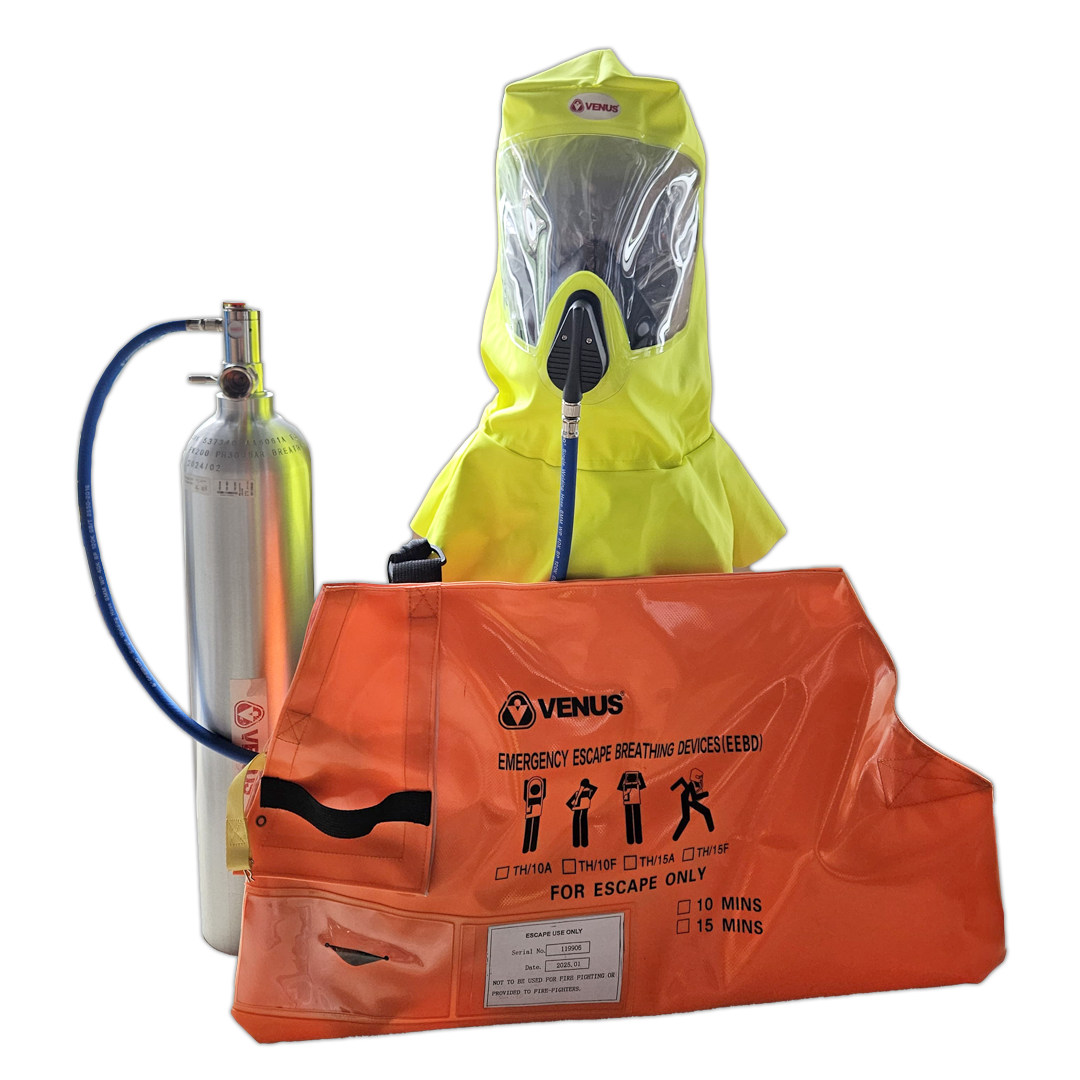 | Emergency Life Support Apparatus- ELSA Escape Set Emergency Life Support Apparatus- ELSA Escape Set ELSA-V15 Item# 110377301 *PESO Approved Including aluminium cylinder 3L, Air pipe, protective hood, carry bag, cylinder valve, Silicon half mask... View product → |
Frequently asked questions
What is an ELSA escape set?
An ELSA, or Emergency Life Support Apparatus, is a compressed-air escape apparatus for one trained wearer leaving a contaminated or oxygen-deficient area. It is not designed for entry, firefighting, rescue or extended work inside the hazard zone.
How do you put on and start an ELSA escape set?
Follow the manufacturer’s training procedure: remove the set from its container, secure the hood or facepiece, open the cylinder valve or activate the starting mechanism, check the airflow and leave immediately. Do not improvise the sequence; practise it under supervision using the exact model supplied.
How long does an ELSA set last?
The escape time depends on the cylinder capacity, rated duration, wearer’s breathing rate and conditions. Use the manufacturer’s rated duration as an evacuation limit, not as permission to remain in the hazard area.
Where should an ELSA set be kept and maintained?
Keep it in a clearly marked, readily accessible position near designated escape routes, protected from heat, chemicals, impact and unauthorised use. Inspect the seal, cylinder pressure, expiry information, hood or facepiece and case condition according to the manufacturer’s schedule.
How should you specify an ELSA escape set for a hospital or workplace?
Define the contaminant and oxygen-deficiency risks, evacuation distance, number of users, required duration, facepiece or hood design, storage points, training plan and inspection arrangements. Confirm that the selected model’s approval and instructions match the intended workplace use.
Keywords